
10 Things to Check Before Renting Construction Equipment in Chennai
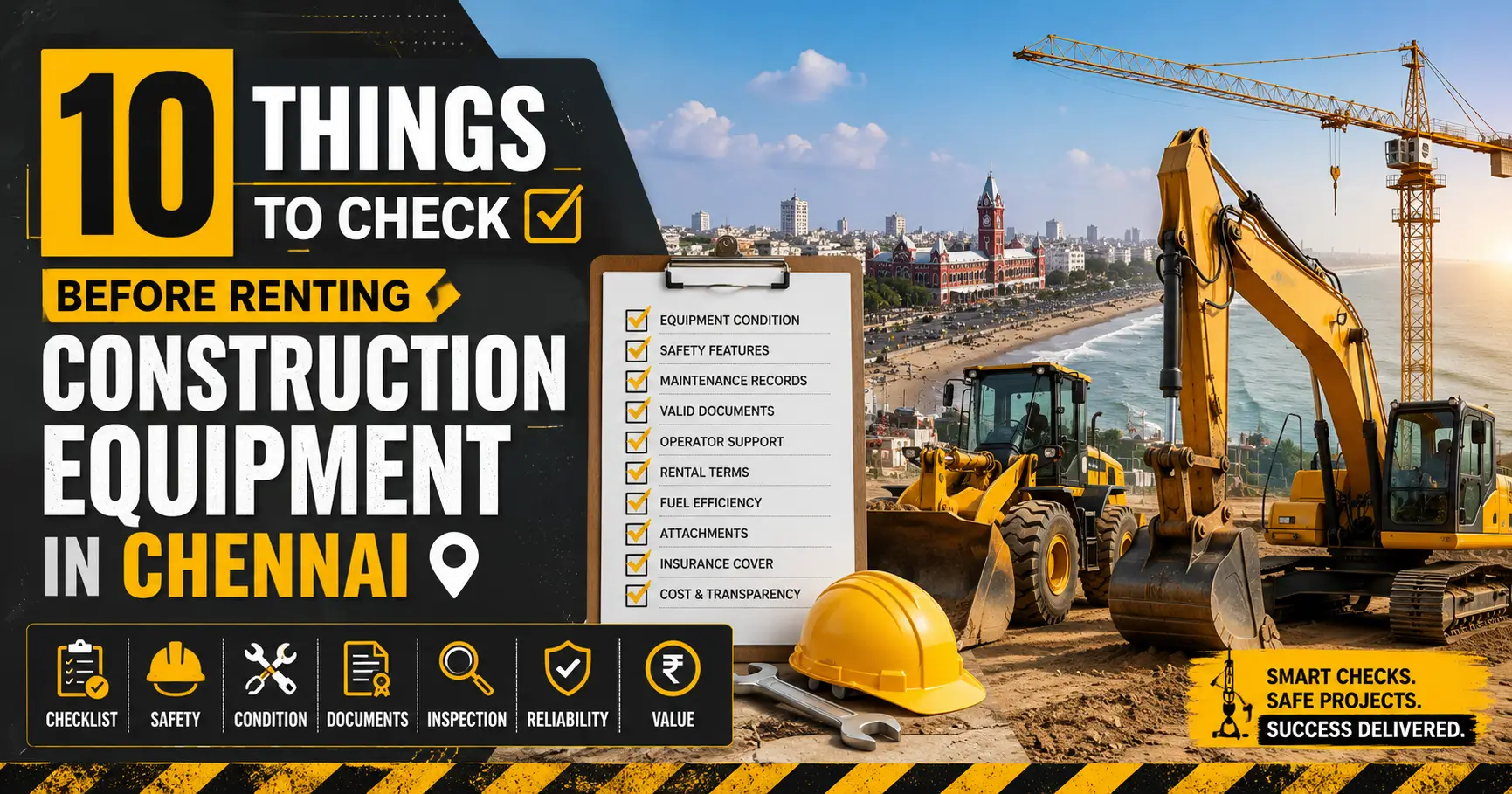
Choosing reliable construction equipment rental in Chennai can make a major difference to the safety, cost, and progress of your construction project. Whether you are working on a residential building, commercial complex, road project, industrial facility, or infrastructure development, the right equipment helps your team complete demanding tasks efficiently. However, selecting a machine based only on rental price can lead to downtime, unexpected repair costs, safety concerns, and project delays. Before signing a rental agreement, it is important to evaluate the equipment, rental company, operating conditions, and contract terms carefully.
Why You Need a Construction Equipment Rental Checklist
A proper construction equipment rental checklist helps you assess a machine before bringing it to your project site. Construction equipment includes excavators, loaders, cranes, forklifts, concrete mixers, compactors, generators, aerial work platforms, and other machinery designed for specific applications. Every machine has different capacity, operating requirements, fuel consumption, dimensions, and safety considerations.
The right equipment should match the actual requirements of your project rather than simply being the largest or most powerful option available. A machine that is unsuitable for the site may consume more fuel, work inefficiently, or create unnecessary safety risks.
Before finalizing construction equipment on rent in Chennai, consider the following ten factors.
1. Check the Equipment's Condition
The physical condition of construction equipment should be your first consideration. A machine may look suitable in photographs, but an in-person inspection can reveal problems that are not immediately visible.
Check for oil leaks, damaged hoses, worn tyres or tracks, cracks, rust, unusual noises, and loose components. Inspect attachments such as buckets, forks, hydraulic breakers, lifting accessories, or blades according to the equipment type.
Ask the rental provider about the machine's maintenance history and previous usage. Well-maintained equipment generally provides more consistent performance and reduces the possibility of unexpected breakdowns.
2. Verify Machine Capacity and Specifications
Different projects require different equipment capacities. Before renting, compare the machine's specifications with your job requirements.
For example, an excavator should be evaluated according to digging depth, operating weight, bucket capacity, reach, and hydraulic performance. Similarly, a crane requires careful evaluation of lifting capacity, boom length, working radius, and site height.
Understanding these specifications is an essential part of knowing how to choose construction equipment rental for a particular application. Avoid selecting equipment based solely on its availability. The machine must have adequate capacity to perform the intended task safely and efficiently.
3. Inspect Maintenance and Service Records
Regular maintenance is critical for heavy machinery. Ask the rental company whether scheduled servicing has been completed and whether inspection records are available.
Important maintenance areas can include engine servicing, hydraulic systems, brakes, tyres, electrical components, filters, lubrication, transmission, and safety mechanisms.
A company that follows preventive maintenance practices is generally better positioned to provide dependable machinery. For example, established providers such as Everest Engineering Equipment can help customers understand equipment-related requirements before deployment.
4. Confirm Safety Features and Compliance
Safety should never be compromised to save money on rental charges. Before accepting a machine, verify that essential safety systems are functioning properly.
Depending on the equipment, inspect emergency controls, alarms, lights, seat belts, guards, reverse-warning systems, load indicators, stabilizers, and operator controls. Make sure the equipment is suitable for the working environment and complies with applicable safety requirements.
Operators should also receive proper instructions regarding machine operation, limitations, and safe working procedures. If the rental involves lifting equipment, pay particular attention to rated capacity and safe working load.
5. Consider the Site Conditions
Construction sites in Chennai can vary considerably. A project may involve narrow urban roads, congested commercial areas, soft ground, uneven surfaces, limited access, or restricted working space.
Before selecting machinery, consider the available space, ground conditions, access routes, overhead obstructions, working height, and transportation requirements. Large equipment may have excellent capacity but may not be practical for a confined site.
This is one of the most important things to check before renting construction equipment, because equipment suitability depends not only on the job but also on the physical environment where the machine will operate.
6. Understand Rental Terms and Total Cost
The advertised rental price is not always the final cost. Ask the rental provider to explain exactly what is included in the quotation.
Clarify whether transportation, fuel, operator charges, insurance, maintenance, mobilization, demobilization, and taxes are included. Also ask about overtime charges, additional working hours, and penalties for extending the rental period.
When comparing construction equipment rental requirements, calculate the overall project cost rather than choosing the provider offering the lowest basic rental rate. A slightly higher rental price may provide better-maintained equipment, faster support, or more comprehensive services.
7. Check Availability of Spare Parts and Technical Support
Even well-maintained machinery can experience technical issues during demanding construction work. Therefore, reliable after-rental support is important.
Ask how quickly the rental provider can respond if the machine develops a mechanical or hydraulic problem. Find out whether technicians are available and whether replacement equipment can be arranged if the machine remains unavailable for an extended period.
Before finalizing construction equipment rental in Chennai, discuss the breakdown procedure clearly. Knowing who to contact and what happens during equipment failure can prevent confusion when your project is operating under a tight schedule.
Explore More:- CNC Stirrup Bender | CNC Double Bender | CNC Pile Cage Making Machine
8. Evaluate Operator Requirements
Some construction equipment can be operated only by trained and competent personnel. Before renting, determine whether your project already has qualified operators or whether the rental company provides trained operators.
The operator should understand the machine's controls, load limits, operating procedures, and safety precautions. For complex equipment such as cranes, boom lifts, or specialized material-handling machinery, operator competency becomes especially important.
If an operator is included with the rental, confirm working hours, responsibilities, and additional charges in advance. Clear communication helps prevent operational misunderstandings later.
9. Review Transportation and Delivery Arrangements
Heavy construction machinery cannot always be transported like ordinary vehicles. Equipment may require trailers, permits, loading arrangements, or special transportation planning depending on its size and weight.
Ask the rental company how the equipment will reach your site and whether transportation is included in the quotation. Confirm the delivery location, expected arrival time, unloading requirements, and site access conditions.
For construction equipment on rent in Chennai, transportation planning is particularly important when the project is located in a busy urban area where road access, traffic, and working hours can affect equipment movement.
10. Read the Rental Agreement Carefully
Never finalize equipment rental without reviewing the agreement thoroughly. The contract should clearly explain the rental period, payment terms, equipment condition, responsibilities of both parties, maintenance obligations, insurance arrangements, breakdown procedures, and return conditions.
Check who is responsible for damage caused by misuse, accidental incidents, or normal wear and tear. Also understand the process for extending the rental period or terminating the agreement early.
A clear agreement protects both the customer and rental provider and reduces the possibility of disputes during or after the project.
How to Choose Construction Equipment Rental in Chennai
Knowing how to choose construction equipment rental requires more than comparing hourly or monthly rates. Start by identifying the exact task, required capacity, operating environment, rental duration, and expected workload. Then shortlist providers based on equipment quality, maintenance practices, technical support, delivery capabilities, and transparent pricing.
You can use these three practical steps before making the final decision:
- Define the machine type, capacity, attachments, rental duration, and operating conditions.
- Compare equipment condition, service history, support, transportation, and complete rental costs.
- Inspect the machine and review the rental agreement before accepting delivery.
It is also useful to ask questions before booking. Find out whether the quoted machine is the exact model that will be delivered, whether replacement equipment is available in case of major failure, and whether preventive maintenance is included during longer rental periods.
A reliable provider should be willing to explain these details clearly instead of focusing only on the rental price.
Common Construction Equipment Rental Requirements to Prepare
Having the necessary information ready can make the rental process faster. Rental companies may need details such as the project location, equipment type, required capacity, rental duration, intended application, operating hours, delivery date, and whether an operator is required.
Your construction equipment rental requirements may also depend on the nature of the project. A road construction site may need compactors and loaders, while a building project may require excavators, concrete equipment, lifting machinery, or material-handling solutions.
Prepare your project information before contacting rental providers. This makes it easier to receive an accurate quotation and prevents unsuitable equipment from being recommended.
The second part of your construction equipment rental requirements should focus on site-specific factors such as access restrictions, ground conditions, available power or fuel, working height, and space limitations. Sharing these details with the rental company helps them suggest machinery that can perform effectively in your actual working environment.
Final Thoughts
Selecting construction equipment rental in Chennai should be treated as a project planning decision rather than a simple price comparison. Equipment condition, specifications, maintenance, safety, site suitability, rental terms, technical support, operator requirements, transportation, and contract conditions can all affect project performance.
A careful inspection and clear discussion with the rental provider can help reduce downtime, improve workplace safety, and control unexpected expenses. By evaluating these ten factors before booking, you can choose equipment that matches your project requirements and supports smoother construction operations.
Frequently Asked Questions
1. What should I check before renting construction equipment?
Check equipment condition, capacity, maintenance records, safety features, rental terms, operator requirements, and transportation arrangements.
2. Is equipment inspection necessary before rental?
Yes. Inspecting the machine can help identify damage, leaks, worn components, and operational issues before you accept it.
3. Should I choose construction equipment based only on price?
No. Consider machine condition, performance, support, transportation, maintenance, and total rental cost along with the basic price.
4. Can I rent construction equipment with an operator?
Yes. Many rental providers offer equipment with trained operators, depending on the machine type and rental arrangement.
5. What information should I provide to a rental company?
Provide the project location, equipment type, required capacity, rental duration, intended application, delivery date, and relevant site conditions.