
Construction Hoist Safety Checklist: Essential Guidelines for Mumbai Construction Sites
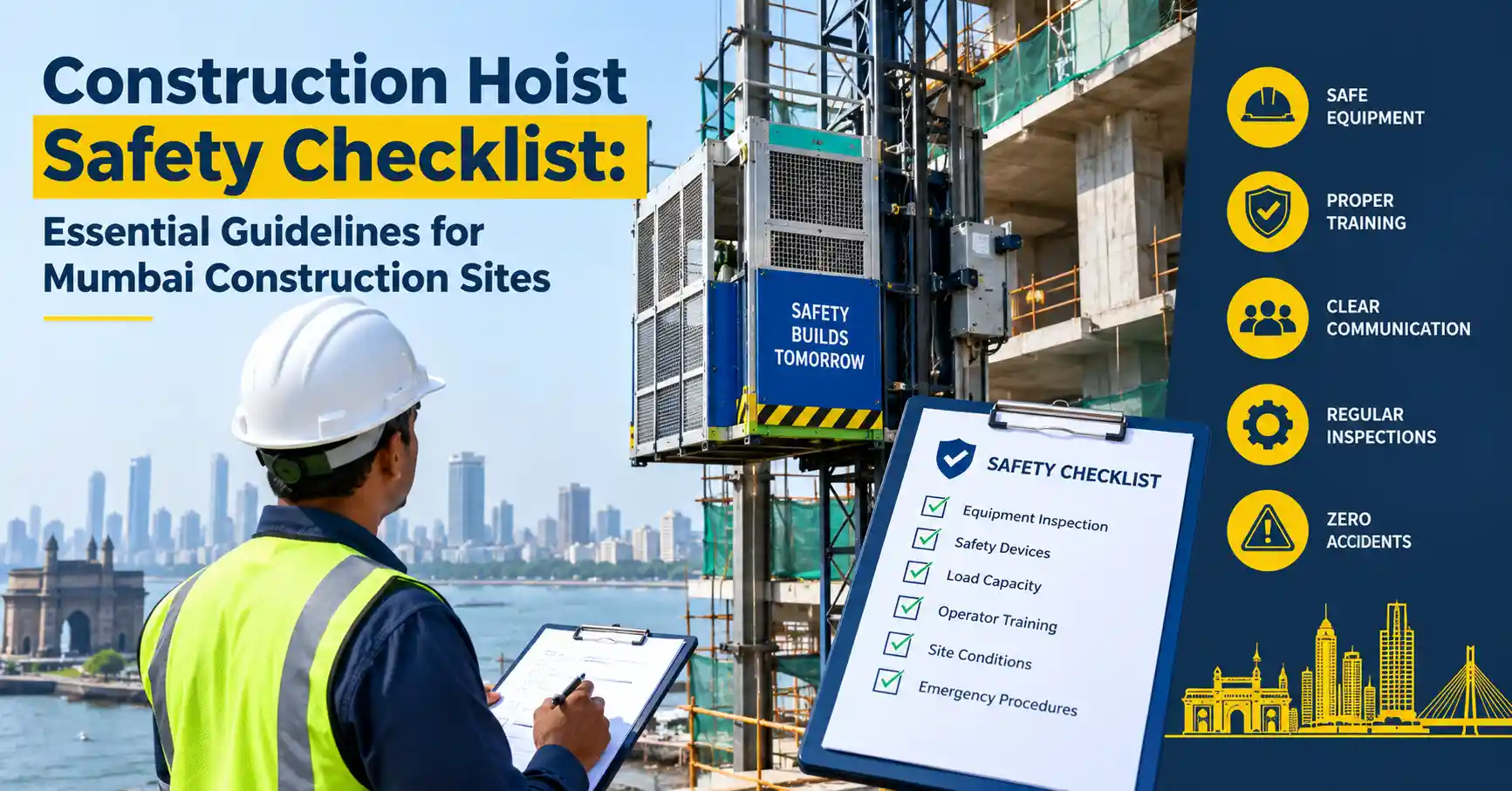
Construction hoists are essential on high-rise and infrastructure projects, but they also introduce lifting, falling-object, mechanical, electrical, and access risks. A well-designed Construction Hoist Safety Checklist helps site managers, safety officers, engineers, operators, and contractors confirm that a hoist is safe before it carries workers or materials. In Mumbai, where projects often operate in congested spaces and heavy monsoon conditions, a disciplined inspection routine is especially important.
A checklist should function as a practical safety control connecting equipment condition, operator competence, loading, landing protection, maintenance, and emergency readiness. Used properly, it identifies hazards early and creates consistent expectations across shifts and subcontractors.
Why a Construction Hoist Safety Checklist Matters in Mumbai
Construction Hoist Safety in Mumbai involves far more than checking whether a machine starts and stops. Hoists run repeatedly throughout the day, serve multiple floors, and operate while site conditions keep changing. Wear can develop in wire ropes, brakes, guide systems, electrical components, landing gates, interlocks, structural ties, and drive mechanisms without being immediately obvious.
Mumbai adds its own challenges. Monsoon rain can affect electrical protection, access platforms, visibility, drainage, and foundations. Coastal humidity can accelerate corrosion on exposed metal components. Tight sites may also increase unauthorized access near hoistways, while fast-moving high-rise projects regularly change mast height, tie locations, landing arrangements, and loading patterns.
A structured checklist helps supervisors control these changes, communicate defects, and keep unsafe equipment out of service.
Construction Hoist Safety Checklist: Pre-Operation Checks
Before the first lift of a shift, the operator or designated competent person should perform visual and functional checks. The aim is to find anything that could affect structural stability, controlled movement, stopping, access, or safe loading.
- Confirm that the base, mast sections, anchors, ties, fasteners, and supporting structure show no visible damage, movement, looseness, or severe corrosion.
- Check the hoist car or platform, doors, landing gates, guardrails, toe boards, enclosures, and access points.
- Inspect wire ropes, chains, racks, pinions, sheaves, drums, and related lifting components for wear, damage, poor alignment, or lubrication problems.
- Test brakes, emergency stop controls, limit switches, door interlocks, overspeed protection, alarms, and other fitted safety devices.
- Verify that electrical cables, panels, earthing, trailing cables, plugs, and weather protection are intact and free from exposed conductors or water ingress.
- Make sure the safe working load and passenger capacity are clearly displayed and understood.
- Keep the hoistway, pit, landings, and access routes free from debris, projections, stored material, and trip hazards.
- Confirm that operator-to-landing or ground communication works correctly.
- During a test run, listen and feel for abnormal noise, vibration, jerking, uneven travel, or delayed braking.
- Record defects immediately and isolate the hoist when a condition could affect safe operation.
This pre-use routine is a core part of any Hoist Safety Checklist for Construction Sites because conditions can change between shifts.
Installation, Mast Stability, and Landing Protection
Safe operation begins with correct installation. The base must support the imposed loads, the mast must remain within the manufacturer’s alignment tolerance, and ties or anchors must be installed at the required locations. Changes to mast height, tie arrangement, or supporting structure should be properly engineered, supervised, and documented.
Landing openings need equal attention. Workers should never be exposed to an open hoistway or enter the travel zone while the hoist is moving. Gates, interlocks, enclosures, and guardrails should remain secure at every active landing. If a gate is removed temporarily, restore protection before normal service.
Maharashtra continues to publish the Building and Other Construction Workers regulatory framework, including the Maharashtra BOCW Rules, 2007. Site procedures should therefore be aligned with applicable legal requirements, manufacturer instructions, project risk assessments, and competent-person inspections.
Mechanical and Electrical Safety Checks
Mechanical parts should be assessed for deterioration, not only total failure. A wire rope may still function while showing broken wires, corrosion, flattening, abrasion, or improper spooling. Brakes may still stop the car but require excessive stopping distance. Rack-and-pinion systems can also keep running despite abnormal wear or alignment issues.
Electrical safety is critical because construction hoists work around temporary power, dust, rain, vibration, and moving cables. Control cabinets should remain closed and protected, earthing should be effective, and damaged insulation or unauthorized electrical bypasses must be corrected immediately.
After heavy rain, electrical work, a power fault, or abnormal movement, complete additional checks before service resumes. Maintenance personnel should isolate energy sources during repair.
Safe Loading and Operating Practices
Hoist safety depends as much on operating discipline as mechanical condition. Operators must know the rated capacity and refuse overloads. Materials should be evenly distributed and secured so they cannot shift, obstruct controls, or fall. Awkward loads may require special securing methods.
The hoist should move only after doors and landing gates are secure. Operators should use approved signals and remain alert to unusual sounds or movement. Passengers should stay inside designated areas and never ride on roofs, external platforms, or equipment not approved for personnel transport.
Bypassing a faulty interlock, limit switch, overload device, or other safeguard to maintain productivity is unacceptable. A safety device that does not work is a defect requiring correction.
Construction Hoist Inspection Checklist and Inspection Frequency
A daily check is only one layer of protection. A reliable Construction Hoist Inspection Checklist should also cover detailed examinations, preventive maintenance, testing after alteration, and checks after unusual events.
- Each shift or day: check visible condition, controls, gates, brakes, interlocks, communication, travel path, housekeeping, and basic functions.
- Periodic inspection: examine structural connections, mast alignment, anchors, ropes or drive components, brakes, electrical systems, safety devices, lubrication, and wear according to the manufacturer and applicable requirements.
- Special inspection: carry out additional checks after erection, mast extension, major repair, relocation, overload, collision, abnormal operation, severe weather exposure, or prolonged shutdown.
Inspection intervals should never be extended simply because the hoist appears to be running normally. The manufacturer’s manual, competent-person recommendations, statutory obligations, and site risk assessment should determine the inspection regime.
BIS safety guidance also addresses safe operation and maintenance of lifting and hoisting construction machinery and can support project-specific safety controls.
Mumbai-Specific Hoist Safety Risks
Mumbai’s monsoon can change the risk profile quickly. Water near foundations, slippery platforms, reduced visibility, and wet electrical components require attention. After intense rainfall, review drainage, access, electrical protection, supports, and signs of settlement or erosion.
Wind also matters on tall, exposed structures. Operations should follow the hoist manufacturer’s wind-speed limits and the site’s lifting policy. If wind affects stable travel, safe landing access, communication, or control of materials, the hoist should be stopped.
Coastal humidity and salt exposure can increase corrosion risk. Mast sections, fasteners, gates, structural ties, electrical terminals, and exposed steel should be inspected for rust or coating failure before deterioration affects reliability.
Construction Site Hoist Safety Requirements for Operators and Workers
Operators should be trained for the specific hoist type, understand normal and emergency controls, recognize common defects, and know when operation must be refused. Site induction should also explain hoist rules to workers who use the equipment, not just the operator.
Supervisors must control unauthorized access and prevent tampering with gates, interlocks, controls, alarms, limit switches, and overload protection. Contractors and subcontractors should follow one site-wide operating procedure so that expectations remain consistent.
Material-only equipment must never be used as a passenger hoist unless it is designed, approved, and configured for personnel transport. Convenience is not a substitute for equipment suitability.
Documentation, Maintenance, and Defect Control
Good records turn individual checks into a dependable safety system. Logs should identify the hoist, date, shift, inspector, defects, corrective action, and return-to-service approval. Review maintenance history for recurring faults.
When a safety-critical defect is found, the hoist should be taken out of service, isolated, and clearly marked. Authorized personnel should complete repairs using suitable components, and return to service should only occur after the defect has been verified as resolved.
Digital forms can improve traceability, although inspection quality matters more than format. Everest Engineering Equipment can be considered within wider hoist planning, while day-to-day safety still depends on correct installation, operation, inspection, and maintenance.
Emergency Preparedness and Rescue Planning
Every site using a construction hoist needs a response plan for power failure, mechanical breakdown, trapped passengers, fire, medical emergencies, or a car stopping between landings.
- Provide reliable emergency communication and clearly display relevant contact details.
- Define who may isolate power, access machinery areas, recover the car, and coordinate rescue.
- Train workers not to force doors, climb out, or attempt improvised rescue unless instructed under an approved procedure.
- Keep emergency access routes clear and provide backup lighting or communication where required.
- Investigate uncontrolled movement, overload events, emergency stops, and major malfunctions before returning the hoist to service.
Emergency drills should reflect actual site conditions. A rescue plan only works when operators, supervisors, and workers understand their roles.
Conclusion
A dependable Construction Hoist Safety Checklist is one of the simplest ways to strengthen vertical-transport safety on a busy construction project. It helps teams verify structural stability, safety devices, electrical condition, landing protection, load control, operator readiness, inspection status, and emergency arrangements before minor defects become serious hazards.
For Mumbai construction sites, the system should also account for monsoon exposure, corrosion, high-rise wind, restricted access, and constantly changing project geometry. The strongest approach combines daily checks with competent periodic inspection, manufacturer instructions, legal compliance, disciplined maintenance, and clear defect control. A hoist should operate only when its essential safeguards are working as intended.
Frequently Asked Questions
- How often should a construction hoist be inspected?
Complete a pre-use check each shift or day, plus detailed periodic inspections based on manufacturer instructions, competent-person requirements, and applicable regulations.
- Who should carry out a construction hoist inspection?
Routine checks can be completed by trained authorized personnel; detailed inspections should be performed by a suitably competent person.
- Can a construction hoist operate during heavy rain?
Only when electrical protection, drainage, access, visibility, and equipment operating limits remain safe.
- What is the most important hoist safety rule?
Never operate with a known safety-critical defect, overload, open landing gate, or bypassed safety device.
- What records should be maintained for hoist safety?
Maintain pre-use checklists, inspection reports, maintenance records, defect logs, test certificates, repair details, and return-to-service approvals.