
Top Benefits of Using a Lattice Girder Machine in Construction
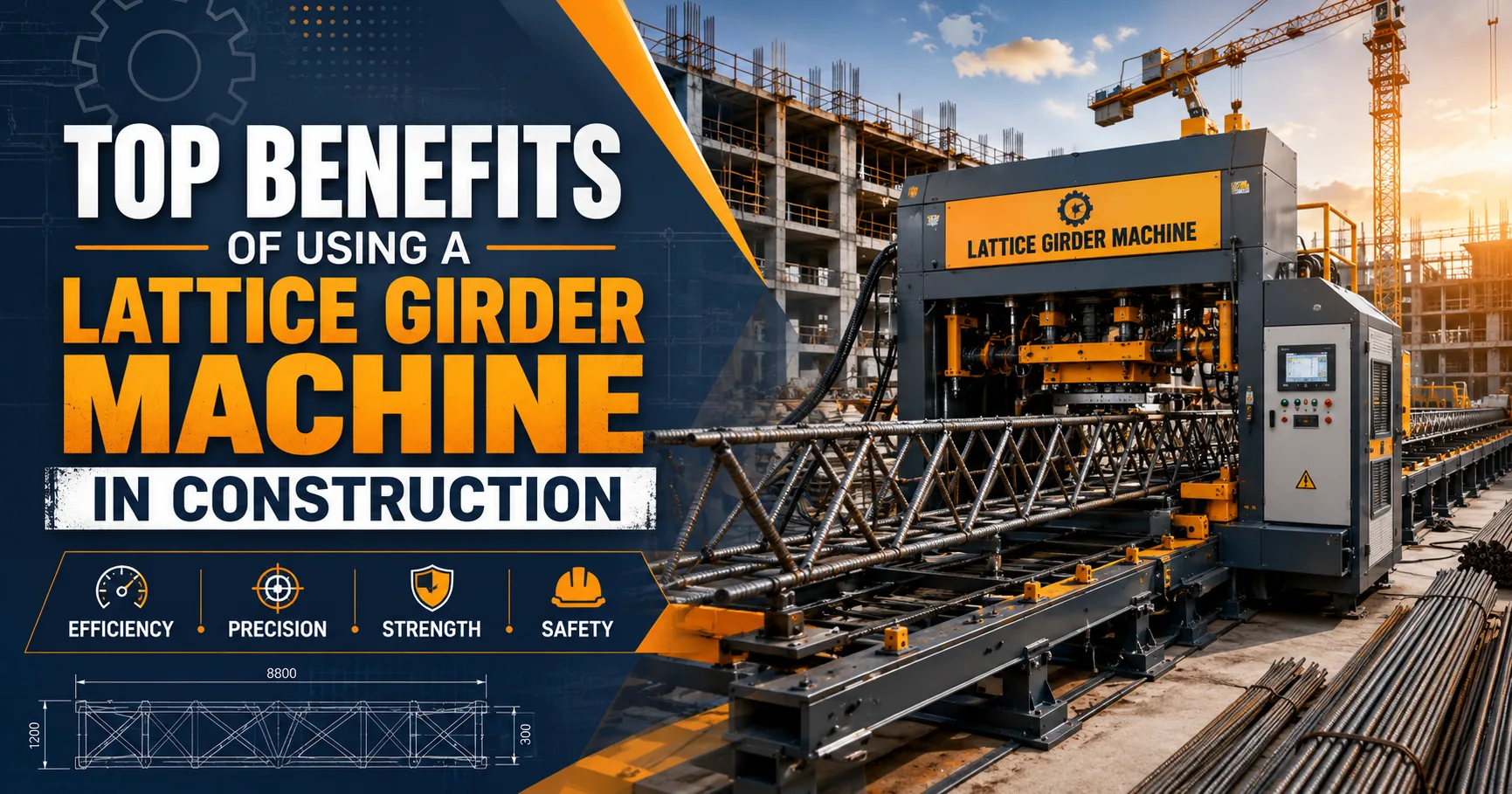
Construction projects today demand speed, precision, and consistent quality. Whether it is tunnel excavation, underground infrastructure, mining support systems, or large civil engineering projects, manufacturers need reliable equipment to produce strong lattice girders efficiently. A Lattice Girder Machine plays a crucial role in automating the production process, ensuring every girder meets industry standards while reducing labor costs and production time.
As modern construction techniques continue to evolve, contractors and manufacturers are investing in advanced machinery that improves productivity without compromising structural strength. This article explains the key advantages of using a lattice girder manufacturing system and why it has become an essential investment for construction businesses.
What is a Lattice Girder Machine?
A Lattice Girder Machine is an automated system designed to manufacture lattice girders by accurately welding steel bars into a predefined framework. These girders are widely used as structural support elements in tunnels, underground metro projects, mining operations, hydroelectric projects, and slope stabilization works.
Unlike traditional manual fabrication, automated production delivers consistent dimensions, precise welding, and higher production capacity. The machine integrates advanced control systems that minimize errors while maintaining excellent product quality throughout the manufacturing process.
Why the Construction Industry Relies on a Lattice Girder Machine
The growing demand for infrastructure projects has increased the need for faster and more reliable manufacturing solutions. A Lattice Girder Machine enables manufacturers to produce high-quality reinforcement structures with minimal manual intervention.
Its ability to automate repetitive processes improves operational efficiency while ensuring every girder complies with engineering specifications. This makes it an ideal solution for companies handling large-scale construction and infrastructure projects.
Top Benefits of Lattice Girder Machine in Construction
The Benefits of Lattice Girder Machine go beyond simple automation. Modern equipment helps manufacturers improve quality, increase output, and reduce operational costs while meeting strict construction standards.
1. Higher Production Efficiency
Automation significantly increases production speed compared to manual fabrication methods. Continuous feeding, welding, and cutting processes allow manufacturers to complete more girders within shorter production cycles.
This improved efficiency enables companies to meet tight project deadlines while maintaining consistent product quality.
2. Consistent Product Quality
Uniformity is essential in construction components. Automated systems ensure every girder is manufactured according to precise dimensions and engineering specifications.
Accurate alignment and controlled welding reduce defects, minimizing the chances of structural inconsistencies during installation.
3. Precision Welding Performance
A high-quality Lattice Girder Welding Machine produces strong and reliable weld joints that enhance the structural integrity of every girder.
Computer-controlled welding parameters maintain consistent heat input and weld quality, reducing material waste and the need for post-production corrections.
4. Lower Labor Requirements
Manual fabrication often requires skilled welders and continuous supervision. Automated machinery reduces dependence on manual labor by handling repetitive manufacturing tasks efficiently.
This allows skilled workers to focus on quality control, equipment maintenance, and other high-value operations instead of repetitive production activities.
5. Reduced Material Waste
Precise feeding and automated welding improve raw material utilization. Better control over steel bar positioning minimizes unnecessary wastage and helps manufacturers optimize production costs.
Reduced scrap generation also contributes to more sustainable manufacturing practices.
6. Faster Project Completion
When production capacity increases, construction companies receive lattice girders more quickly. This helps contractors maintain project schedules without delays caused by slow manufacturing.
Timely delivery is especially important for large infrastructure projects where multiple construction phases depend on continuous material supply.
7. Enhanced Workplace Safety
Automation minimizes direct worker exposure to welding operations and heavy material handling.
Modern safety features, automated controls, and protective systems create a safer working environment while reducing workplace accidents associated with manual fabrication.
anti collision device for train
weld mesh manufacturing machine
How a Lattice Girder Welding Machine Improves Manufacturing
A Lattice Girder Welding Machine uses automated welding technology to create strong, consistent joints between steel components. Compared to manual welding, automated systems provide better penetration, improved weld strength, and repeatable quality.
Additional advantages include:
- Consistent welding quality across every production batch.
- Reduced human error during fabrication.
- Improved production speed for large-volume manufacturing.
These improvements help manufacturers deliver products that meet stringent engineering and quality requirements.
Advantages of Using a Lattice Girder Manufacturing Machine
A modern Lattice Girder Manufacturing Machine combines material feeding, positioning, welding, and cutting into a single integrated production line.
Key advantages include:
- Automated workflow that increases operational efficiency.
- Better dimensional accuracy and production consistency.
- Reduced maintenance compared to multiple standalone production systems.
With integrated automation, manufacturers can streamline production while lowering operating costs and improving overall productivity.
Why a Lattice Girder Production Machine Supports Large Infrastructure Projects
Infrastructure projects often require thousands of lattice girders within limited timelines. A Lattice Girder Production Machine enables manufacturers to meet these demands through continuous, high-capacity production.
The automated process reduces production bottlenecks while ensuring consistent quality across every batch. As project requirements increase, manufacturers can scale production without significantly increasing labor costs.
Modern production machines also offer programmable controls that allow operators to adjust product specifications according to project requirements, providing greater flexibility for different applications.
Importance of a Lattice Girder Machine for Tunnel Construction
Tunnel projects require reliable structural reinforcement to maintain excavation stability during construction. A Lattice Girder Machine for Tunnel Construction manufactures precision-engineered girders capable of supporting shotcrete applications and underground structures.
Because tunnel construction demands high accuracy and dependable structural components, automated manufacturing ensures every girder satisfies required engineering standards.
Whether used in railway tunnels, highway tunnels, metro systems, or mining operations, a Lattice Girder Machine for Tunnel Construction helps contractors maintain quality while accelerating project execution.
Factors to Consider Before Buying a Lattice Girder Machine
Choosing the right equipment requires evaluating several technical and operational factors:
- Production capacity based on daily manufacturing requirements.
- Welding technology, automation level, and control system.
- Material compatibility with different steel bar sizes.
- Machine durability, maintenance requirements, and after-sales support.
- Energy efficiency and long-term operating costs.
Selecting equipment from an experienced manufacturer also ensures better technical assistance, spare parts availability, and operator training. Companies such as Everest Engineering Equipment focus on delivering advanced machinery designed to meet modern construction industry requirements.
Future of Automated Lattice Girder Manufacturing
Automation continues to transform construction manufacturing. Smart production systems now include programmable logic controllers (PLC), servo-driven automation, digital monitoring, and quality inspection technologies that improve manufacturing accuracy.
Future developments may include AI-assisted quality monitoring, predictive maintenance, remote diagnostics, and IoT-enabled production tracking. These innovations will help manufacturers increase productivity while maintaining high-quality standards and reducing operational costs.
Conclusion
A Lattice Girder Machine has become an essential solution for manufacturers involved in modern infrastructure, mining, and underground construction projects. By improving production speed, welding accuracy, product consistency, and workplace safety, automated machinery delivers long-term value for businesses seeking higher efficiency and better quality. Investing in advanced manufacturing technology not only supports current production demands but also prepares manufacturers for the future of automated construction equipment.
Frequently Asked Questions
1. What is a lattice girder machine used for?
It is used to manufacture lattice girders for tunnels, mining projects, underground structures, and civil engineering applications.
2. What are the main benefits of a lattice girder machine?
It improves production speed, welding accuracy, product consistency, safety, and overall manufacturing efficiency.
3. How does a lattice girder welding machine improve quality?
It performs precise automated welding that produces uniform, strong, and reliable weld joints with minimal defects.
4. Where is a lattice girder machine commonly used?
It is widely used in tunnel construction, metro rail projects, mining, hydroelectric works, and underground infrastructure development.
5. Why should manufacturers invest in automated lattice girder production?
Automation reduces labor costs, increases production capacity, minimizes material waste, and ensures consistent product quality.